Normalization vs Denormalization: The Database Design Dilemma
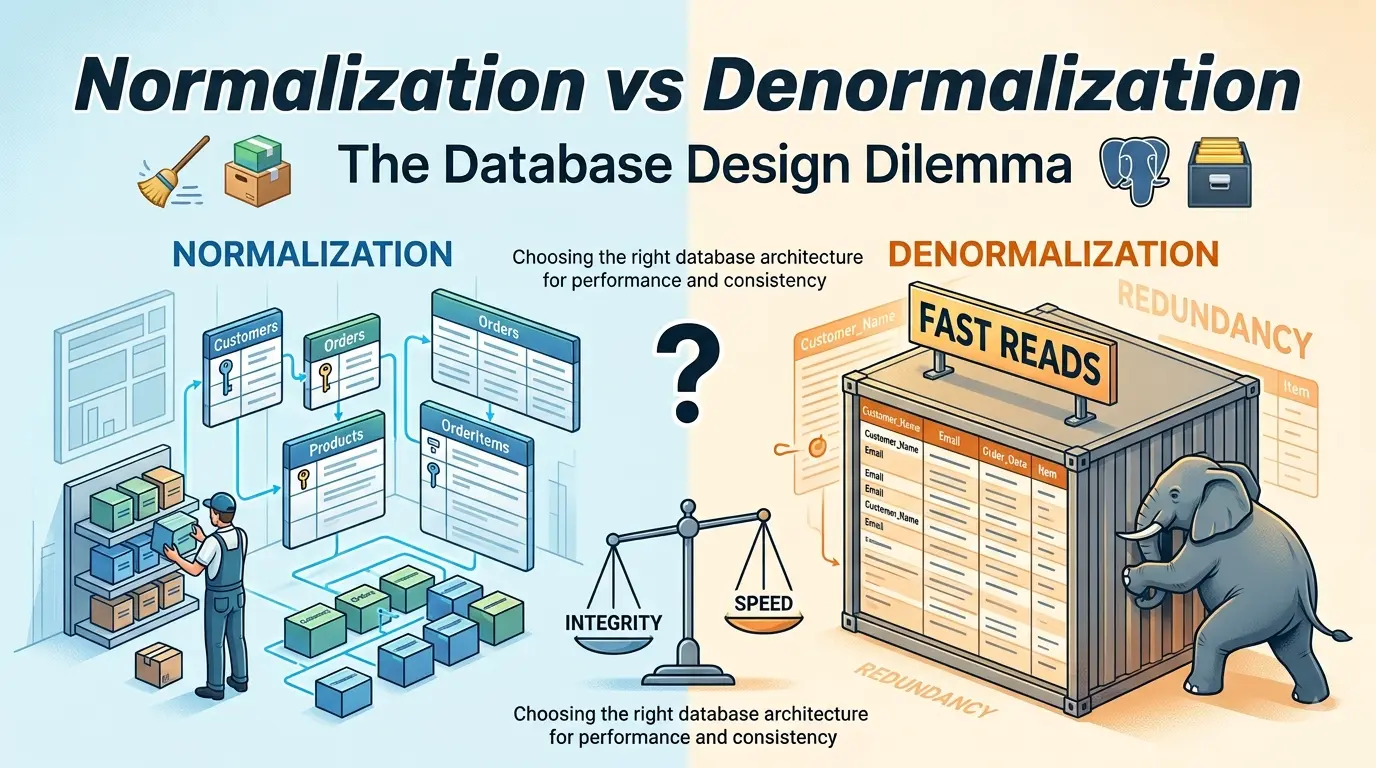
Normalization vs Denormalization: The Database Design Dilemma 🗄️
Every developer eventually faces this question: should I split my data into many small, perfectly interconnected tables, or keep it simple with fewer, bloated ones? 🤔 This is the eternal battle between normalization and denormalization two opposite yet equally important data modeling strategies.
Choosing the wrong one can lead to a slow application that collapses under load, or a codebase drowning in convoluted queries and update anomalies. Getting it right keeps your database consistent, fast, and maintainable. 💪
In this guide, you'll learn:
- 🧩 What normalization and denormalization actually mean
- 🏷️ The three normal forms (1NF, 2NF, 3NF) without the academic mumbo-jumbo
- ⚖️ The pros, cons, and trade-offs of each strategy
- 📊 Real-world SQL examples of both approaches
- 🧠 How to decide which one fits your application
- 💡 Hybrid strategies used by real-world systems
What is Normalization? 🧹
Normalization is the process of organizing data to minimize redundancy and dependency by dividing large tables into smaller ones and defining relationships between them.
The goal is simple: each piece of data should live in exactly one place and be referenced everywhere else through keys.
✅ Before:
customer_name    customer_email    order_id    order_total   product_name
John Doe         j@mail.com        101         250.00        Laptop
John Doe         j@mail.com        102         75.00         Mouse

💰 After:
customers      (id, name, email)
orders         (id, customer_id, total)
order_items    (id, order_id, product_name, price)
Notice how customer_name and customer_email are stored once, not repeated on every order.
The Three Normal Forms 📏
Normalization is formalized through a series of "normal forms." Most applications aim for Third Normal Form (3NF).
| Normal Form | Rule | What it prevents |
|---|---|---|
| 1NF | Every cell holds a single, atomic value | Lists and repeating groups inside a column |
| 2NF | No partial dependency on a composite key | Columns tied to only part of a composite key |
| 3NF | No transitive dependency on a non-key column | Columns depending on other non-key columns |
Note: There are stricter forms (BCNF, 4NF, 5NF) but they're rarely worth the added complexity in real applications.
What is Denormalization? 🐘
Denormalization is the deliberate introduction of redundancy into a database, typically by merging related data into fewer tables or duplicating columns across tables.
It's the opposite of normalization not because it's "wrong," but because it optimizes for a different goal: read performance over write consistency.
✅ Denormalized:
orders:
  id    customer_name    customer_email    total
  101   John Doe         j@mail.com        250.00
  102   John Doe         j@mail.com        75.00

Readable in one query, but John Doe's email now exists twice.
Normalization vs Denormalization ⚔️
| Criteria | Normalization 🧹 | Denormalization 🐘 |
|---|---|---|
| Storage | Less redundant, compact | More redundant, larger footprint |
| Write speed | More complex (multiple tables) | Faster (fewer tables to update) |
| Read speed | Slower (JOINs required) | Faster (all in one place) |
| Data integrity | High (single source of truth) | Risk of inconsistency |
| Update cost | Cheap and localized | Expensive and error-prone |
| Query complexity | Complex joins & subqueries | Simple, flat queries |
| Best for | OLTP, transactional systems | OLAP, read-heavy analytics |
Real-World SQL Examples 💻
Normalized Schema (3NF) 🧹
CREATE TABLE customers (
  id    SERIAL PRIMARY KEY,
  name  VARCHAR(100) NOT NULL,
  email VARCHAR(100) NOT NULL
);

CREATE TABLE orders (
  id          SERIAL PRIMARY KEY,
  customer_id INTEGER NOT NULL REFERENCES customers(id),
  total       NUMERIC(10, 2) NOT NULL
);

-- Fetching a customer's order history requires a JOIN:
SELECT c.name, o.id AS order_id, o.total
FROM customers c
JOIN orders o ON o.customer_id = c.id
WHERE c.email = 'j@mail.com';
Denormalized Schema 🐘
CREATE TABLE orders (
  id            SERIAL PRIMARY KEY,
  customer_name VARCHAR(100) NOT NULL,
  customer_email VARCHAR(100) NOT NULL,
  total         NUMERIC(10, 2) NOT NULL
);

-- Fetching the same data? No JOIN needed:
SELECT customer_name, id AS order_id, total
FROM orders
WHERE customer_email = 'j@mail.com';
The Big Trade-Off: Write vs Read ⚖️
How Normalization Hurts Reads
Every read that combines related data requires a JOIN. On large tables without proper indexes, these joins become expensive and can crush query performance.
-- Lots of joins = slower reads ⚠️
SELECT p.name, c.name AS category,
       s.name AS supplier, o.quantity
FROM products p
JOIN categories c   ON c.id = p.category_id
JOIN suppliers s    ON s.id = p.supplier_id
JOIN order_items o  ON o.product_id = p.id;
How Denormalization Hurts Writes (And Integrity)
The real danger isn't slower writes it's data inconsistency. If a customer changes their email, you must update it everywhere it was duplicated:
-- One update, but the email exists in multiple places 🚨
UPDATE orders SET customer_email = 'new@mail.com'
WHERE customer_id = 123;

-- If you miss one table, you now have conflicting data. 😱
This is called an update anomaly, and it's the primary reason denormalization is risky.
Pros and Cons 🧭
Normalization Pros ✅
- 🛡️ Single source of truth, guaranteeing data integrity
- 🪶 Less redundant storage
- 🔐 Modifications stay consistent across the database
- 🔍 Easy to reason about relationships
Normalization Cons ❌
- 🐌 Reads require complex JOINs
- 📈 Slower as joins span more tables
- 🎛️ More tables to manage and maintain
Denormalization Pros ✅
- ⚡ Lightning-fast reads (no JOINs)
- 📄 Simple, flat queries
- 🧮 Great for analytical workloads & dashboards
Denormalization Cons ❌
- 📦 Data duplication bloats storage
- 🧨 High risk of inconsistency
- ❌ Update anomalies can corrupt correctness
When to Use Which? 🧠
Choose Normalization When:
- 📈 Data changes frequently (OLTP systems)
- 🧾 Data integrity is non-negotiable (banking, e-commerce checkout)
- 🔗 Entities have complex, evolving relationships
- 🏗️ You're designing the system from scratch
Choose Denormalization When:
- 🔍 Data is mostly read, rarely written (analytics, reporting)
- 🚀 Read performance is the top priority
- 🎯 You need to serve reports and dashboards at scale
- 🤝 Working with NoSQL, where joins don't exist
The Hybrid Reality 💡
Real-world systems are rarely 100% normalized or 100% denormalized. The winning move is a hybrid: keep your source of truth normalized, and cache or duplicate read-optimized versions where it matters.
1. Denormalized Read Models (CQRS)
Write to your normalized store, then project a denormalized read model for queries:
normalized_tables  ──►  sync / event  ──►  denormalized_read_model
     (source of truth)                        (blazing fast reads)
2. Cached Denormalization
Store a denormalized view in a cache (Redis, Memcached) and rebuild it when the underlying data changes.
3. Materialized Views 🪞
Many databases support materialized views a denormalized snapshot that refreshes on a schedule:
CREATE MATERIALIZED VIEW sales_by_region AS
SELECT region, SUM(total) AS revenue
FROM orders o
GROUP BY region;

-- Refresh it periodically:
REFRESH MATERIALIZED VIEW sales_by_region;
Decision Checklist 📋
Ask yourself these questions before modeling your data:
- ❓ How often will this data be read vs written?
- ❓ Do I need real-time consistency, or is eventual consistency acceptable?
- ❓ How many tables will a typical read query have to join?
- ❓ Is storage cost or query speed my bigger constraint?
- ❓ Can I afford a caching/read-model layer to get the best of both?
Rule of thumb: Start normalized. Denormalize deliberately and measurably only after profiling shows a real read bottleneck.
Summary & Key Takeaways 🎯
- 🧹 Normalization minimizes redundancy and maximizes integrity great for writes and complex transactions.
- 🐘 Denormalization trades integrity for read speed great for analytics and read-heavy workloads.
- ⚖️ There's no universally "correct" answer, only the best answer for your workload.
- 💡 Start normalized, then denormalize specific hot paths with caches, materialized views, or read models.
- 🧪 Always measure first. Premature denormalization risks era-eras of inconsistency for gains you may never need.
Understanding the trade-off between normalization and denormalization is one of the most valuable skills in database design. Once you master it, you'll stop guessing and start engineering schemas that perform beautifully under real-world traffic. 🚀✨

Written by Aymen Isfiaya
Senior Frontend Developer & Atlassian Forge Specialist sharing web dev techniques, React patterns, and cloud extension insights.